



Interested in the Fibonacci or Labouchere roulette betting systems?
Both are structured staking methods designed to guide how wagers are adjusted during play. While each follows a different progression, neither changes the mathematical odds of roulette. Discover how these systems work, how they compare and why responsible bankroll management should always come first.
Explore Lord Ping and the live casino category for more educational roulette guides.
What Is the Fibonacci Roulette Betting System?
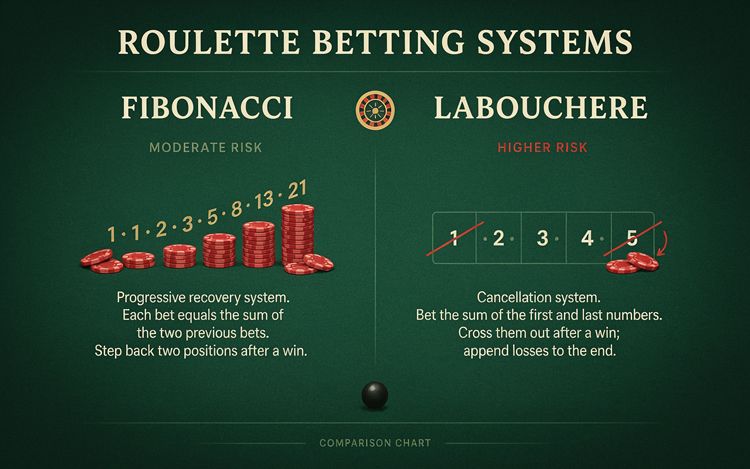
The Fibonacci betting system is based on the famous Fibonacci number sequence, where each number equals the sum of the two preceding numbers.
The sequence begins:
1, 1, 2, 3, 5, 8, 13, 21...
When applied to roulette:
- Start with one betting unit.
- Move one step forward in the sequence after every loss.
- Move back two numbers after every win.
- Continue until you return to the beginning or reach your planned stopping point.
The strategy is typically used on even-money bets such as Red or Black, Odd or Even, and High or Low.
|
💡 The Fibonacci sequence provides structure for stake progression, but it cannot predict when winning spins will occur. |
How Does the Fibonacci System Work?
Suppose your betting unit is £5.
|
Spin |
Result |
Stake |
Fibonacci Position |
Next Stake |
|
1 |
Loss |
£5 |
1 |
£5 |
|
2 |
Loss |
£5 |
2 |
£10 |
|
3 |
Loss |
£10 |
3 |
£15 |
|
4 |
Win |
£15 |
Back two steps |
£5 |
Unlike the Martingale system, stake increases are gradual rather than doubling after every loss.
Results are determined by the spin of the roulette wheel in live play or by a Random Number Generator (RNG) in digital games. Outcomes are entirely based on chance.
What Is the Labouchere Betting System?
The Labouchere system, also known as the Cancellation System, uses a sequence of numbers selected by the player before betting begins.
For example:
1 – 2 – 3 – 4
The first and last numbers are added together to determine the opening stake.
In this example:
£1 + £4 = £5 stake
After each outcome:
- A winning bet removes the first and last numbers from the sequence.
- A losing bet adds the amount just wagered to the end of the sequence.
The objective is to eliminate every number from the list.
How Does the Labouchere System Work?
Using the sequence 1 – 2 – 3 – 4:
|
Spin |
Result |
Stake |
Updated Sequence |
|
1 |
Win |
£5 |
2 – 3 |
|
2 |
Loss |
£5 |
2 – 3 – 5 |
|
3 |
Loss |
£7 |
2 – 3 – 5 – 7 |
As losing bets extend the sequence, stake sizes can gradually increase during prolonged losing runs.
|
💡 Many players appreciate the flexibility of the Labouchere system because they choose the opening sequence themselves, allowing it to reflect their planned budget. |
Fibonacci vs Labouchere
|
Feature |
Fibonacci |
Labouchere |
|
Progression |
Fixed number sequence |
Player-created sequence |
|
Stake increases |
Follow Fibonacci numbers |
Based on sequence values |
|
Complexity |
Simple |
Moderate |
|
Flexibility |
Limited |
Highly customisable |
|
Bankroll demands |
Moderate |
Can increase significantly during long losing streaks |
Although both systems approach progression differently, they remain subject to the same mathematical principles.
Which System Is Simpler?
The Fibonacci strategy is generally easier for beginners because it follows a fixed numerical pattern that requires little calculation during play.
The Labouchere system offers greater flexibility but demands closer attention to the changing sequence after every spin. Players who lose track of the sequence may find it difficult to apply consistently.
Neither system is inherently better. The choice depends on personal preference rather than any mathematical advantage.
Important Limitations
No betting progression changes how roulette works.
Whether using Fibonacci, Labouchere or any other staking method:
- Every roulette spin is independent.
- Previous outcomes do not influence future results.
- The house edge remains unchanged.
- Long losing streaks remain possible.
- Table betting limits may interrupt progression.
Understanding these limitations helps set realistic expectations before playing.
Responsible Play Comes First
Both Fibonacci and Labouchere are bankroll management techniques rather than winning systems.
Before beginning any roulette session:
- Decide on a spending limit.
- Set a session time.
- Choose a profit target and a loss limit.
- Never increase your budget to recover previous losses.
- Stop once your predetermined limits have been reached.
For independent guidance on safer gambling, consult the UK Gambling Commission, GamCare and BeGambleAware. These organisations provide practical tools, advice and support for responsible gambling.
Final Thoughts
The Fibonacci and Labouchere roulette betting systems each provide a structured way to manage wagers during play. Fibonacci relies on a fixed mathematical sequence, while Labouchere allows players to customise their progression before the session begins. Educational resources from Lord Ping explore both approaches to help players understand how they function in practice.
Despite their differences, neither system alters roulette's underlying probabilities. Every spin remains random, the house edge always applies, and no staking method guarantees favourable outcomes. The most effective strategy is to gamble responsibly, manage your bankroll carefully and treat roulette as entertainment rather than a source of income.
FAQs
What is the Fibonacci roulette betting system?
The Fibonacci system increases stakes according to the Fibonacci number sequence after losses and moves back two positions following a win.
How does the Labouchere betting system work?
The Labouchere system uses a player-created sequence of numbers. Winning bets cancel numbers from the sequence, while losing bets add new numbers to the end.
Is Fibonacci better than Labouchere?
Neither system is mathematically superior. They use different staking methods but are both subject to the same house edge and random outcomes.
Can either system guarantee profits in roulette?
No. Neither Fibonacci nor Labouchere can predict results or overcome the mathematical advantage held by the casino.